
How the five Probably Stolen reputation tracks work, what raises and lowers them, and how faction standing changes prices, access and security.
Probably Stolen Reputation and Factions
Probably Stolen tracks your standing with five station groups: Lower Levels, Upper Levels, Security, Black Market, and Revolution. The bars run from −200 to +200, and the bottom of each bar is marked Blacklisted. Reputation is not a single morality score; it is a set of relationships that decide who walks into your shop, what they will pay, and who comes looking for you.
This guide explains the tracks, the known ways to move them, and the practical consequences. For the criminal side, see crime and investigation. For the people who pay you, see customers and requests.
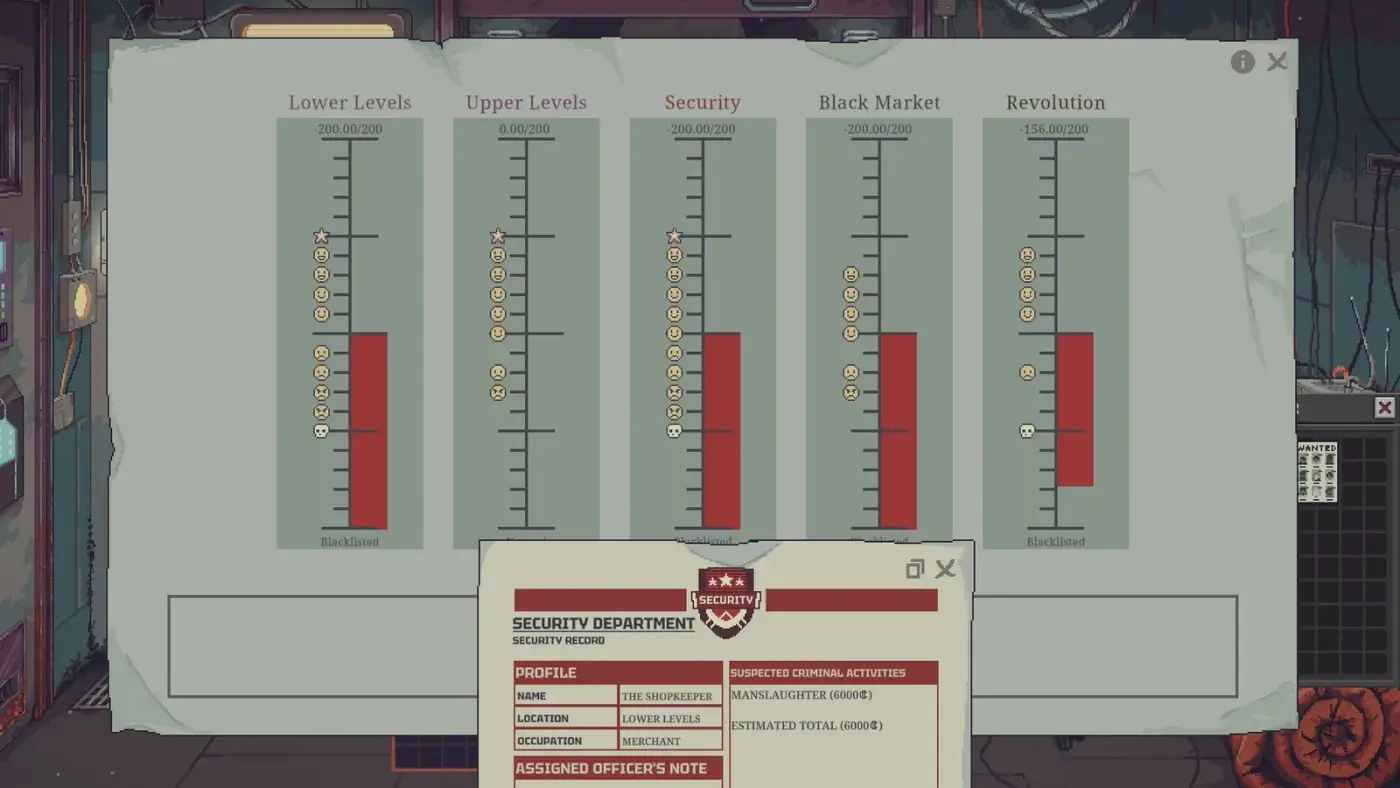
The five tracks
| Track | What it represents | Typical effect |
|---|---|---|
| Lower Levels | Poor and working-class station residents | Access to cheap labor, scavengers, and street buyers |
| Upper Levels | Wealthy residents and officials | Higher-ticket customers and property access |
| Security | Station police and inspectors | Inspections, permits, and investigation pressure |
| Black Market | Criminals, fixers, and smugglers | Contraband supply and illicit buyers |
| Revolution | Anti-station militants | Rebel contacts and anti-security opportunities |
The exact threshold for each named rank is not published in the build used for this page. The bar's scale and the Blacklisted marker are visible, but the intermediate labels are community observations. Treat the numbers as directional until the game exposes a full rank table.
Reputation is not Wild's Favor
Two similar-looking systems are easy to confuse:
- Faction reputation is the five-track standing described above. It changes access and dialogue.
- Wild's Favor is a separate currency used at Wild's Network to unlock fixers, informants, suppliers, services, and gunsmith stock.
Wild's Favor is spent, not earned as a reputation score. In the network screen it appears next to available credits, and the fixer service has a nightly fee. Do not spend favor on a convenience item if you are saving for a supplier unlock.
What raises reputation
The reliable positive actions are:
- Selling genuine goods at a fair price.
- Completing customer requests without cheating them.
- Reporting criminals to Security.
- Supporting a faction's preferred outcome in a dispute.
- Keeping the shop attractive and paying rent on time.
On Cozy mode, reputation gains are multiplied by 1.5 and losses by 0.5. On Thin Margins, gains are multiplied by 0.75 and losses by 1.25. That makes hard mode less forgiving of the same mistake.
What lowers reputation
- Selling counterfeit or contaminated goods.
- Refusing a legitimate customer.
- Harbouring stolen goods or contraband.
- Attacking or killing station residents.
- Breaking a faction's rules during a request.
The security record screen shows suspected criminal activities with a credit value. A manslaughter entry, for example, is listed at 6,000 credits. That value feeds the investigation system; it is not a fine you can pay at the counter.
Each track can fall to Blacklisted. Once there, the group's customers and services may refuse you. Repairing the relationship takes deliberate work, not just waiting.
Security reputation is different
Security standing is the one track that can end a run indirectly. A high Security reputation makes permits and inspections easier. A low one raises suspicion, invites raids, and makes it harder to sell legal goods without questions.
If you are running a Fence or Black Market build, you do not need to be loved by Security. You do need to avoid being the obvious suspect. Keep contraband out of the display window, avoid leaving evidence in storage, and use fixers when an investigation starts.
Revolution and the station conflict
The Revolution track represents the militants who oppose the station authorities. Helping them can unlock rebel contacts and alternate supply lines, but it puts you in direct conflict with Security. The two tracks often move in opposite directions.
The screenshot above shows Revolution at −156 out of 200, which is deep in the hostile range but not yet Blacklisted. That is a useful reminder that the bar is wider than a simple good/evil switch. You can be disliked by a faction without being locked out.
Reputation and prices
Faction standing affects who enters the shop and how they negotiate. A customer from a faction you have helped is more likely to accept a fair price; a hostile customer may lowball, refuse, or report you.
Do not assume a higher reputation means higher prices across the board. A wealthy Upper Levels customer may pay more for luxury goods, while a Lower Levels customer may pay less but buy more often. Match the stock to the customer, not to a single reputation number.
A practical reputation plan
- Pick a primary customer base. Lower Levels for volume, Upper Levels for margin, Black Market for risk, Security for legal trade, Revolution for conflict.
- Protect the track that can raid you. If you sell contraband, keep Security above the raid threshold.
- Use one faction as a supplier. Reputation discounts and access are worth more than scattered small gains.
- Do not chase all five bars. The tracks conflict; a balanced run is possible but slower.
- Repair early. A small loss is cheaper to fix than a Blacklisted lockout.
Reputation and achievements
The Diplomatic achievement requires maximum reputation with any faction. That is a long-term goal, not a first-week target. If you are going for it, pick the faction whose customers already visit your shop and route your requests toward them.
The Snitches Get Riches achievement requires reporting 10 criminals. That will raise Security standing and lower Black Market standing. Plan the trade-off before you start.
FAQ
How many reputation tracks are there? Five: Lower Levels, Upper Levels, Security, Black Market, and Revolution.
What is the maximum reputation? The bar runs from −200 to +200. The exact rank names at each threshold are not fully documented.
Can I recover from Blacklisted? The game allows reputation to move both ways, but recovery requires deliberate actions for that faction. Do not expect it to decay back to neutral on its own.
Does reputation affect the buyout? It affects income, access, and risk, which indirectly affect how quickly you can afford the deed. It is not a separate buyout requirement.
Community source: in-game reputation screen and security record, Steam Community guides ↗, and the official store page ↗. Workshop examples on the Steam Workshop ↗.
Related
More Probably Stolen Guides
A complete Probably Stolen chemistry guide: blender loss, heating plate temperatures, chem finisher contamination, purity tiers and machine module math.
Probably Stolen chemistry recipes with temperatures, yields, purity targets and machine notes for Dream Dust, Nightmare Dust, caffeine and Phanta.
How crime, suspicion, wanted bounties, security records, fixers, and raids work in Probably Stolen, plus how to keep contraband out of a search.
How Probably Stolen customers work: lower and upper level buyers, security, black market, haggling, special requests, and how to match stock to demand.
Probably Stolen difficulty explained: Price Gouge, Mark Up and Thin Margins modifiers, rent increases, permit costs, reputation multipliers and Endless Mode.
How to lay out a Probably Stolen shop: display cases, counter flow, attractiveness, theft risk, storage placement and the best use of limited floor space.
Probably Stolen endings explained: the shop buyout win, the end-of-run stats screen, failure states, Endless Mode and what carries into a new run.
Step-by-step Probably Stolen mod installation: subscribing on Steam Workshop, enabling mods, load order, manual installs, updates, backups and uninstall.