
All Probably Stolen machines, what they produce, how recipe chips, Energy Cells and overnight cycles work, and which machine to buy first.
Probably Stolen Machinery Guide: Machines and Power
Machines turn Probably Stolen from a buy-low-sell-high shop into a production business. They also introduce the game's most expensive mistakes: a machine without a recipe chip, a cycle without an Energy Cell, or a production line with no buyer. This guide covers the machine roster and the operating rules that apply across all of them.
For the modules that go inside machines, see the modules guide. For chemistry-specific temperatures, see the chemistry guide.
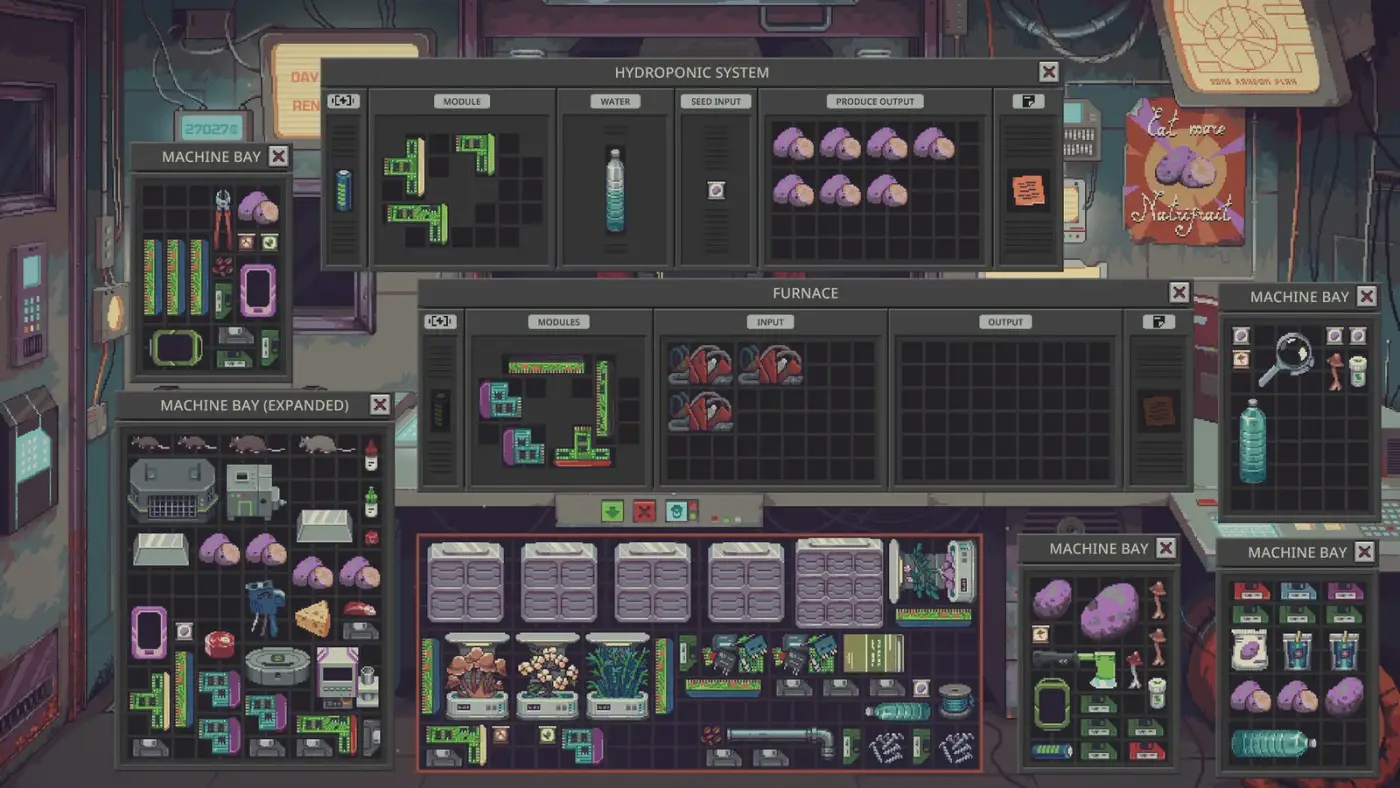
The machine roster
| Machine | Recipes | Purpose | Input notes |
|---|---|---|---|
| 3D Printer | 15 | Pistols, attachments, springs, bottles | Needs a recipe chip |
| Cryptographic Desequencer | 6 | Access cards and permissions | Needs a recipe chip |
| Chem Finisher | 7 | Pills, vials, injectors | Liquid must be fully dry |
| Hydroponic System | 7 | Crops and plant materials | Needs water, nutrients, power |
| Furnace | 1 | Metal ingots | Ore/scrap input |
| Blender | — | Mixes chemical reagents | Immediate cycle |
| Heating Plate | — | Temperature control | Fixed 99°C without modules |
| Fridge | — | Stores drinks | 100 credits, 2 Energy/day |
| Water Purifier | — | Removes water contaminants | Quality 100% for Pure |
| DNA Manipulator | — | Plant genetics | High-tier farming |
| Mirage Projector | — | Machine-related production | Module discounts apply |
| AgeWell | — | Machine-related production | Module discounts apply |
The roster is not a shopping list. Each machine needs floor space, power, and a supply chain. Buy the machine that removes a bottleneck you already have, not the one that looks most profitable on paper.
Overnight cycles and Energy Cells
Most production machines run overnight. That means:
- The machine consumes power for the whole cycle.
- You need an Energy Cell or equivalent power source.
- The output is ready the next day, not immediately.
- A missing input can waste the cycle.
The Blender is the exception: it processes immediately. The Heating Plate is a tool, not a batch machine. Plan your day around the overnight machines: load them before you close, collect before you open.
A machine that runs out of power mid-cycle may lose the batch. Keep a spare Energy Cell and check the machine's status before starting a long recipe.
Recipe chips
The 3D Printer and Cryptographic Desequencer need recipe chips. A chip unlocks a specific recipe; without it, the machine can run but cannot make that item.
Chips are a supply-chain item, not a one-time unlock for every recipe. If you want a specific gun attachment or access card, confirm you have the chip before you buy the inputs. The same logic applies to special ammo and licensed parts.
Modules change machine performance
Every production machine has a module bay. Modules come in three families:
- Performance — speed or output.
- Efficiency — lower power or input use.
- Quality — higher output quality.
Machine-specific discounts mean a module is worth more in some machines than others. A Quality module in a 3D Printer is reported at 25% effect; in a DNA Manipulator or Hydroponic System it can be 50%. The module list has the full table.
Efficiency modules reduce power draw. A 20-power machine with +25% efficiency draws 15; the minimum is 1. That matters when you run several machines overnight.
Power and layout
Power is a shared shop resource. Adding machines without checking the supply can brown out the shop or force you to choose which machine runs. The Fridge alone draws 2 Energy per day, and it only cools drinks; it does not preserve wine or open water.
Layout matters too. Machines need access for loading and unloading, and storage should be near the machine that uses it. A beautiful production room with no walking space is a worse workshop.
Finish the supply chain for one machine before buying the next. A printer with no chips and no filament is furniture.
Which machine first?
The best first machine depends on your start:
| Start | First machine | Why |
|---|---|---|
| Water Merchant | Water Purifier | You already have the input and the demand |
| Chemist | Chem Finisher | Converts lab work into saleable product |
| Hydroponic Farmer | Hydroponic System | Turns water and seeds into crops |
| Gunsmith | 3D Printer | Supports weapon parts and attachments |
| Apprentice | Fridge or 3D Printer | Low-cost utility or a flexible producer |
| Fence | None yet | Learn the resale loop before adding production |
Do not buy a Furnace first unless you have a metal supply and a buyer for ingots. The single recipe makes it a narrow tool.
Machine value and the buyout
Machines count toward estimated total wealth, which feeds the buyout calculation. That makes a machine an asset, not just a cost. It also means a machine you never use still looks valuable on the end screen while producing nothing.
The buyout is not a reason to buy machines. It is a reason to count the ones you already use correctly. A working production line that pays rent is worth more than a showroom of idle equipment.
Maintenance and failure
Machines can break, lose power, or produce a lower-quality batch. The exact durability system is not fully documented. Treat every machine as a system with inputs, power, modules, and output quality; when the output drops, check the simplest cause first:
- Is the machine powered?
- Is the input the right type and quality?
- Is a module missing or corrupted?
- Is the output container full?
- Is the recipe chip installed?
Most “broken machine” reports are one of those five.
FAQ
How many machines are in Probably Stolen? The main production machines include the 3D Printer, Cryptographic Desequencer, Chem Finisher, Hydroponic System, Furnace, Blender, Heating Plate, Fridge, Water Purifier, DNA Manipulator, Mirage Projector, and AgeWell.
Do machines run while the shop is closed? Most production machines run overnight. Load them before closing and collect the output the next day.
Why does my machine need an Energy Cell? Overnight cycles consume power. Without a cell or equivalent supply, the cycle cannot complete.
Can I move a machine? Machine placement is part of shop layout. Check the build's placement rules before buying; a machine that does not fit is a costly mistake.
Community source: in-game machine descriptions and recipe counts, community machinery testing, and the Steam Community guide hub ↗. Store reference: Probably Stolen ↗. Workshop examples: Steam Workshop ↗.
Related
More Probably Stolen Guides
Probably Stolen water grades, contamination types, test strips, filters, tablets, UV, purifiers and a repeatable workflow for selling clean water.
How winemaking works in Probably Stolen: the Bloobberry Wine recipe, fruit quality, fermentation, clean water and selling wine for a profit.
How Probably Stolen customers work: lower and upper level buyers, security, black market, haggling, special requests, and how to match stock to demand.
Probably Stolen difficulty explained: Price Gouge, Mark Up and Thin Margins modifiers, rent increases, permit costs, reputation multipliers and Endless Mode.
A Probably Stolen mods hub: Workshop categories and tag counts, the most subscribed mods, safe subscription habits, and where to start.
How the five Probably Stolen reputation tracks work, what raises and lowers them, and how faction standing changes prices, access and security.
Probably Stolen storage bays, inventory sorting, capacity limits, storage tabs and the mods that fix inventory management, including what is vanilla.
Probably Stolen translation mods explained: 39 Workshop language packs, Chinese and English tags, install order, font issues and quality checks.