
How crime, suspicion, wanted bounties, security records, fixers, and raids work in Probably Stolen, plus how to keep contraband out of a search.
Probably Stolen Crime Guide: Wanted, Raids and Bribes
Crime in Probably Stolen is not a separate minigame. It is the same shop loop with a second price attached: suspicion. Stolen goods, contraband, counterfeit labels, and violence all create evidence. Evidence becomes an investigation. An investigation becomes a raid, a confiscation, or a security record that follows you.
This guide explains the visible systems and the practical rules for keeping a criminal operation alive. For the reputation consequences, see reputation and factions. For hiding stock, see storage and inventory.
The crime loop
- Acquire risky goods. Stolen items, unlicensed weapons, contraband chemicals, or counterfeit products.
- Create evidence. A sale, a display, a witness, or a security search can expose the item.
- Build suspicion. Security accumulates a suspected crime level and a credit value for the alleged activity.
- Investigate. Security may question you, search the shop, or send an officer.
- Resolve. You can comply, bribe, use a fixer, fight, or flee. Each has a cost.
The exact investigation timer is not published. The important design is that suspicion is a resource: it can be reduced before it becomes a raid, and fixers are the main tool for that.
Wanted criminals and bounties
The Wanted board lists fugitives with bounties. The screenshot shows values from 75 to 500 credits, with names such as James Bailey, The Butcher, Arthur Laffeur, Edin Harrison, Lou, Li Bei Wen, Juan, John Smith, and Leroy.
A bounty is an opportunity and a risk. Turning in a wanted criminal can pay, but the criminal's associates may remember. Do not treat the board as a free money printer; check who is asking and who benefits.
Security record and suspected crimes
The security record screen lists your profile, location, occupation, assigned officer, and suspected criminal activities. Each activity has a credit value. A manslaughter entry is listed at 6,000 credits in the screenshot.
That number is the seriousness of the allegation, not a fixed fine. It contributes to how aggressively Security investigates. A shop with a clean record and a high-value inventory is less suspicious than a shop with a violent entry and a display full of unlicensed guns.
Contraband in the public display is visible. Keep risky stock in storage, and keep storage away from the counter during an inspection.
What counts as a crime
The game does not expose a single crime list, but the systems point to these categories:
| Action | Likely consequence |
|---|---|
| Selling stolen goods | Black Market gain, Security suspicion |
| Selling unlicensed weapons | Permit inspection, confiscation |
| Selling counterfeit labels | Fraud suspicion, customer complaint |
| Selling contaminated water | Liability, reputation loss |
| Attacking a customer | Security record, possible manslaughter |
| Harbouring a wanted criminal | Investigation, raid risk |
| Bribing an officer | Short-term relief, long-term exposure |
The severity depends on the item and the witness. A stolen water bottle is not the same as a stolen military weapon.
Fixers and Wild's Network
Wild's Network is the criminal support system. Unlocking it costs 350 credits in the screenshot, and it offers fixers, informants, suppliers, services, and gunsmith stock. The fixer service silences witnesses and cleans up evidence not yet collected by Security, lowering your suspected crime level at an increased rate.
The fixer has a nightly fee. That makes it a recurring cost, not a one-time bribe. Use it when an investigation is close to a raid, not as a permanent subscription unless your margin supports it.
Other network options include:
- Informant: buys information, including evidence about other criminals.
- Supplier: access to restricted goods.
- Service: tools and upgrades, including permit-related services.
- Gunsmith: firearms at fixed prices.
Wild's Favor is separate from faction reputation. Spending it on a fixer is a strategic choice; spending it on a gun you cannot legally sell is usually a waste.
Bribes versus fixers
A bribe is a direct payment to an officer or official. A fixer is an ongoing service that removes evidence before it reaches Security. The game supports both ideas, but the documented system is the fixer.
If you bribe, assume the officer can be replaced or the record can resurface. If you use a fixer, assume the nightly fee continues. Neither is a permanent immunity.
How to avoid a raid
- Keep contraband out of the display. Use storage bays and locked containers.
- Do not sell to obvious informants. A customer who asks too many questions may be gathering evidence.
- Watch the security record. A rising suspected crime value is a warning, not a score.
- Use fixers early. Cleaning evidence before it is collected is cheaper than cleaning up after a raid.
- Maintain a legal front. Water, food, and ordinary resale give you plausible stock.
- Do not attack unless you can finish the fight. Violence creates the most expensive evidence.
Weapons and permits
Guns are legal with the right permit. The Gunsmith start includes a Class 1 permit, firearms, and ammunition. Without a permit, the same stock is contraband.
Permit costs vary by difficulty: 500 credits on Cozy, 1,500 on Normal, and 2,000 on Hard. Inspections check whether the stock matches the permit. A legal gun with an illegal mod can still be a problem.
Violence and the aug problem
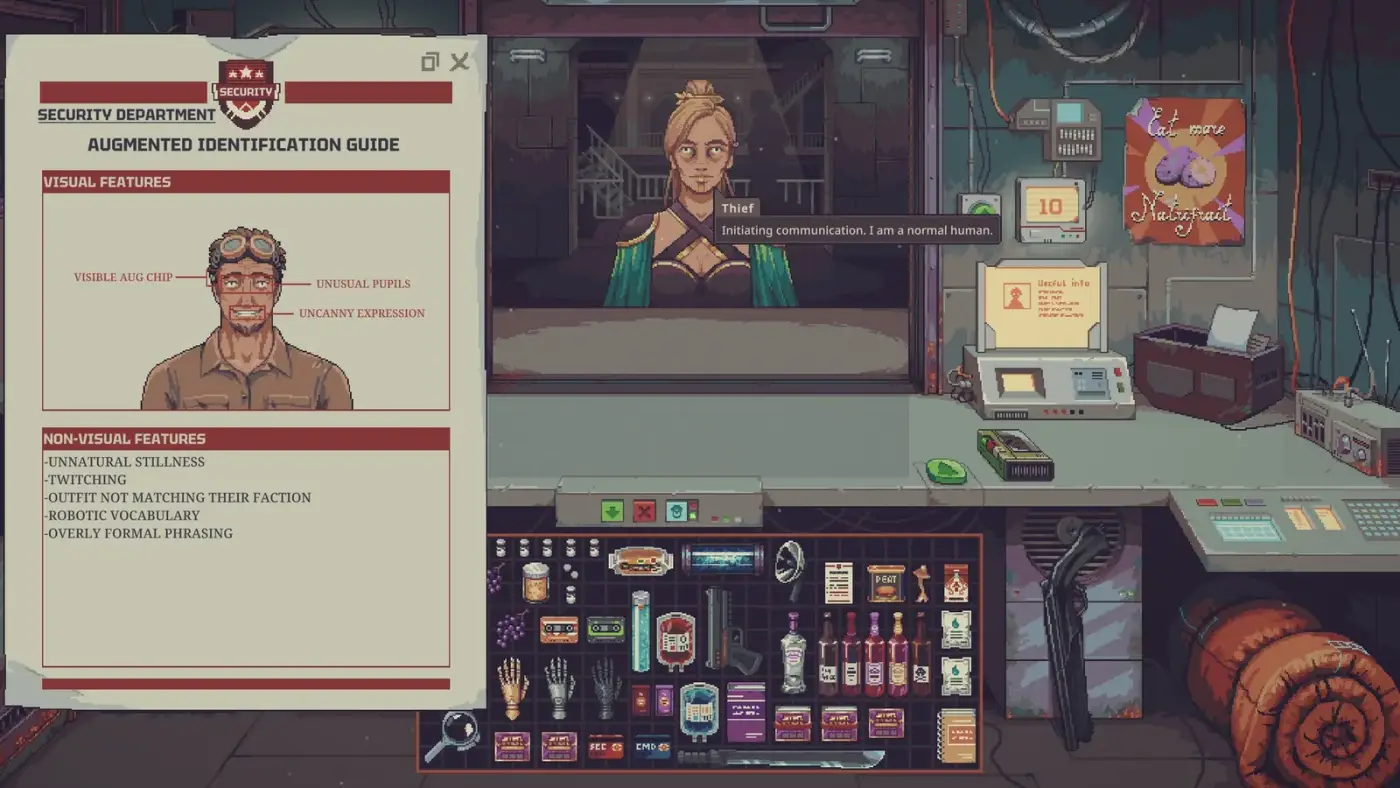
The station has augmented citizens, and Security publishes an identification guide for them. Visual tells include a visible aug chip, unusual pupils, and an uncanny expression; behavioural tells include unnatural stillness, twitching, outfit mismatch, robotic vocabulary, and overly formal phrasing.
The Aug Hunter achievement requires killing 10 augmented citizens. That is a violent path with a corresponding security record. If you are not committed to it, avoid escalating encounters with augs. A customer who says “I am a normal human” may be anything but.
The Clean Hands run
The Clean Hands achievement requires finishing the game without selling stolen or contraband goods. That is the opposite of the Fence playstyle. It does not mean you cannot appraise risky items; it means you cannot sell them.
A clean run is a good way to learn the legal economy. Water, food, licensed guns, and legitimate resale can all fund the buyout. The margin is lower, but the raid risk is much lower too.
FAQ
How do I reduce suspicion in Probably Stolen? Use Wild's fixers to silence witnesses and clean evidence, avoid further risky sales, and keep contraband out of the display.
Can I bribe Security? The documented system is the fixer network. Bribes are referenced in the game's crime fiction but are not as clearly documented as the fixer service.
What happens if I get raided? Security can search the shop and confiscate evidence. The exact penalty depends on the alleged crimes and what is found.
Is crime worth it? It can be, especially for a Fence or Black Market run. It is not worth it if the margin does not cover the fixer fees and the risk of confiscation.
Community source: in-game Wanted board, security record, and Wild's Network screen; Steam Community guides ↗; Probably Stolen store page ↗; Steam Workshop ↗.
Related
More Probably Stolen Guides
Probably Stolen water grades, contamination types, test strips, filters, tablets, UV, purifiers and a repeatable workflow for selling clean water.
How winemaking works in Probably Stolen: the Bloobberry Wine recipe, fruit quality, fermentation, clean water and selling wine for a profit.
How Probably Stolen customers work: lower and upper level buyers, security, black market, haggling, special requests, and how to match stock to demand.
Probably Stolen difficulty explained: Price Gouge, Mark Up and Thin Margins modifiers, rent increases, permit costs, reputation multipliers and Endless Mode.
A Probably Stolen mods hub: Workshop categories and tag counts, the most subscribed mods, safe subscription habits, and where to start.
How the five Probably Stolen reputation tracks work, what raises and lowers them, and how faction standing changes prices, access and security.
Probably Stolen storage bays, inventory sorting, capacity limits, storage tabs and the mods that fix inventory management, including what is vanilla.
Probably Stolen translation mods explained: 39 Workshop language packs, Chinese and English tags, install order, font issues and quality checks.