
A practical Probably Stolen beginner guide: the first-hour loop, what to buy, how appraisal works, and how to keep rent paid without guessing.
Probably Stolen Beginner Guide: Your First Hour
Probably Stolen drops you behind a pawnshop counter with a loan, a rising rent timer, and a station full of people who would rather lie to you than pay retail. The first hour is not about finding the single best item. It is about learning the loop: inspect, appraise, negotiate, stock, sell, and keep enough cash for the next payment.
This beginner guide covers the decisions that actually change a fresh run. For exact item values, use the appraisal guide; for the rent clock, see rent and shop buyout.
Start with the shop, not the catalogue
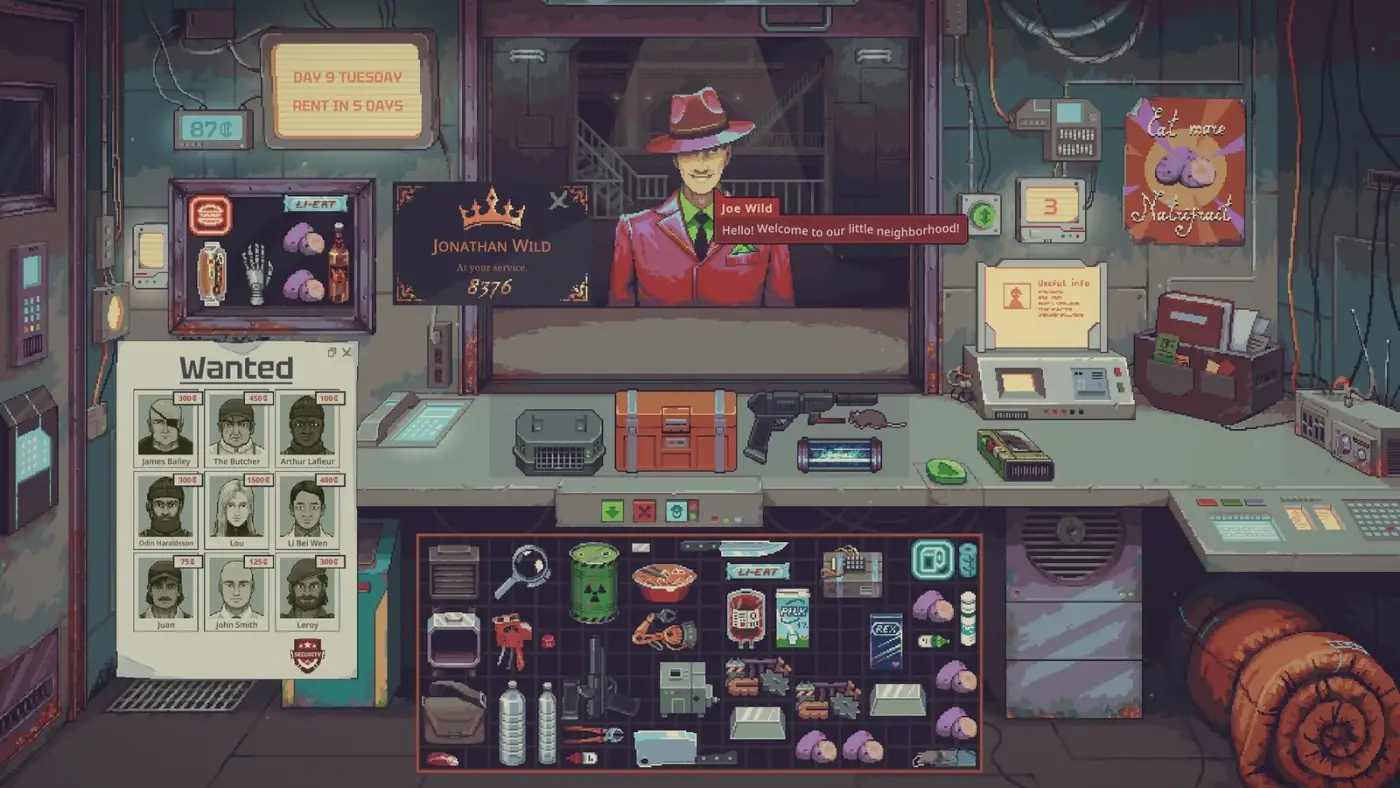
Your storefront is the interface you will use most. The left side shows the customer and the item they place on the counter. The right side is your stock, display space, and the tools you have unlocked. The rent timer sits above the shop and advances with each day.
Do not spend the opening credits on a full shelf. A pawnshop makes money by buying below appraised value and selling above it, not by filling every slot. The first purchases should be cheap, liquid goods you can appraise confidently: water bottles, common chemicals, low-grade tools, and the occasional obvious counterfeit that you can reject or flip to a buyer who does not care.
If you cannot explain why an item is worth its asking price, do not buy it. Appraisal is the profit engine, and guessing is how a starting balance disappears.
Learn the appraisal window first
The magnifying-glass appraisal view is the most important screen in the game. It lets you inspect materials, wear, seals, serial numbers, labels, and other authenticity markers. The station's own guides are deliberately specific: cybernetic hands have material and feature adjustments, plasma cartridges have seal grades, and Ribwich packaging has year, facility, and sticker checks.
You do not need to memorise every table on day one. Learn the structure instead:
| Check | What it tells you | Common beginner mistake |
|---|---|---|
| Base type | Sets the starting value band | Treating a gold-plated hand like aluminium |
| Condition | Wear and damage reduce value | Paying full price for a damaged item |
| Authenticity | Labels, seals, serials, packaging | Assuming every sealed box is genuine |
| Demand | Whether a customer will actually buy it | Buying a rare item with no buyer pool |
Once you know the base type and the condition, you can make a fast offer and leave room for negotiation. The appraisal guide has the full value tables for hands, cartridges, Ribwich, Immunivax, and cigarettes.
Use the first day to map your customers
Customers are not interchangeable. Some are ordinary lower-level citizens looking for a cheap meal or a water bottle. Some are security or augmented citizens who react badly to contraband. Some are thieves, fixers, or faction agents testing whether you will look away.
The practical beginner move is to watch the customer's label and dialogue before you show the expensive stock. A customer who says they are a normal human may be anything but. If a sale feels like a test, it probably is.
Your reputation with the five station tracks — Lower Levels, Upper Levels, Security, Black Market, and Revolution — changes who walks in and what they will pay. You do not need to max a faction on day one. You need to avoid tanking the ones that can raid you.
Buy low, sell at a margin, repeat
The core money loop is simple:
- Buy an item below its appraised value.
- Improve or relabel it only when the margin justifies the risk.
- Price it for the customer in front of you, not for an imaginary perfect buyer.
- Reinvest part of the profit into stock and part into rent security.
A 15% retail markup is the normal-mode baseline described by the difficulty screen. On Cozy mode the markup is 20%; on Thin Margins there is no automatic retail markup at all. That single number changes how aggressively you can buy.
Do not confuse revenue with profit. A 400-credit sale that cost you 350 credits, a permit fee, and a repair is not a win. Keep a cash buffer for rent, because a bad purchase can otherwise turn into a missed payment and a downward spiral.
The first three purchases that make sense
| Purchase | Why it works | Risk |
|---|---|---|
| Water bottles and filters | Constant demand, easy to test, low capital | Contamination and liability |
| Common chemical supplies | Feeds the chemistry line later | Heavy-metal contamination |
| Cheap tools or machine parts | Useful for upgrades and resale | Low margin if bought at full price |
Avoid spending your opening balance on a single expensive appraisal item unless you already know its markers. A fake gold hand or a cracked cartridge can wipe out the profit from ten small sales.
Set up one production line, not five
New players often try to run water, wine, chemistry, and guns at the same time. The station rewards depth. Pick one line that matches your starting scenario and learn its machine cycle before adding another.
- Water Merchant starts with a HydraTech purifier and can sell clean water almost immediately.
- Chemist starts with lab equipment and can push toward higher purity.
- Hydroponic Farmer starts with a growing system and can supply wine or food ingredients.
- Fence starts with stolen goods and needs a plan for security attention.
- Rock Bottom starts with nothing and is the hardest learning curve.
If you picked Apprentice, treat the first run as a tutorial for appraisal and rent rather than a race to buy the shop. The starting scenarios page compares all nine paths.
Keep the rent timer visible
Rent is the quiet fail state. Every day you spend buying stock is a day closer to the payment. The difficulty screen sets the pressure: rent rises by 2% per payment on Cozy, 5% on Normal, and 10% on Hard. Missing rent hurts your attractiveness, which reduces customer traffic, which makes the next payment harder.
The fix is boring and effective: keep a rent reserve, and do not tie all your cash into slow-moving inventory. If a deal would leave you unable to pay, the deal is too big.
FAQ
How long should the first hour take? There is no fixed timer. A useful first session covers the tutorial, a handful of appraisals, one full buy-sell cycle, and the first rent payment. Do not restart just because you made a bad buy; the recovery is part of the game.
Should I buy the most expensive item I can afford? Usually no. Buy the item you can appraise and resell fastest. Expensive inventory ties up cash and increases the cost of a mistake.
Do I need to pick a permanent profession? No. The starting scenario gives you equipment and a direction, but you can master other trades during the run.
Community source: Probably Stolen on Steam ↗ and the Steam Community guide hub ↗. Workshop availability checked on the Steam Workshop ↗.
Related
More Probably Stolen Guides
Probably Stolen water grades, contamination types, test strips, filters, tablets, UV, purifiers and a repeatable workflow for selling clean water.
How winemaking works in Probably Stolen: the Bloobberry Wine recipe, fruit quality, fermentation, clean water and selling wine for a profit.
How Probably Stolen customers work: lower and upper level buyers, security, black market, haggling, special requests, and how to match stock to demand.
Probably Stolen difficulty explained: Price Gouge, Mark Up and Thin Margins modifiers, rent increases, permit costs, reputation multipliers and Endless Mode.
A Probably Stolen mods hub: Workshop categories and tag counts, the most subscribed mods, safe subscription habits, and where to start.
How the five Probably Stolen reputation tracks work, what raises and lowers them, and how faction standing changes prices, access and security.
Probably Stolen storage bays, inventory sorting, capacity limits, storage tabs and the mods that fix inventory management, including what is vanilla.
Probably Stolen translation mods explained: 39 Workshop language packs, Chinese and English tags, install order, font issues and quality checks.